Category
Research
Ultrasound
Year
2026
Market
Defense
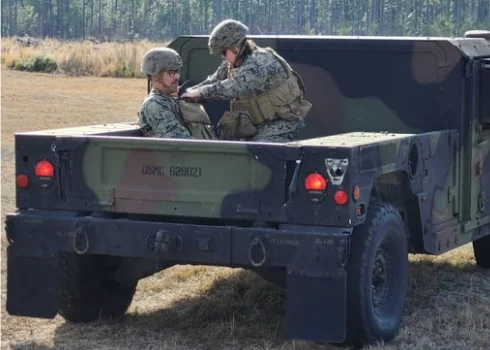
Traumatic brain injury accounted for 32.4% of casualties for U.S. servicemen in Iraq and Afghanistan; yet the tools to detect evolving intracranial hypertension in forward environments are rarely available. In those critical early hours, clinicians are often left making high-stakes neurological decisions without imaging, without specialists, and without any reliable way to monitor intracranial pressure (ICP). ONSD assessed with ultrasound is a promising portable, accurate, and radiation free diagnostic ideally suited for forward and austere military settings.
The Study at a Glance
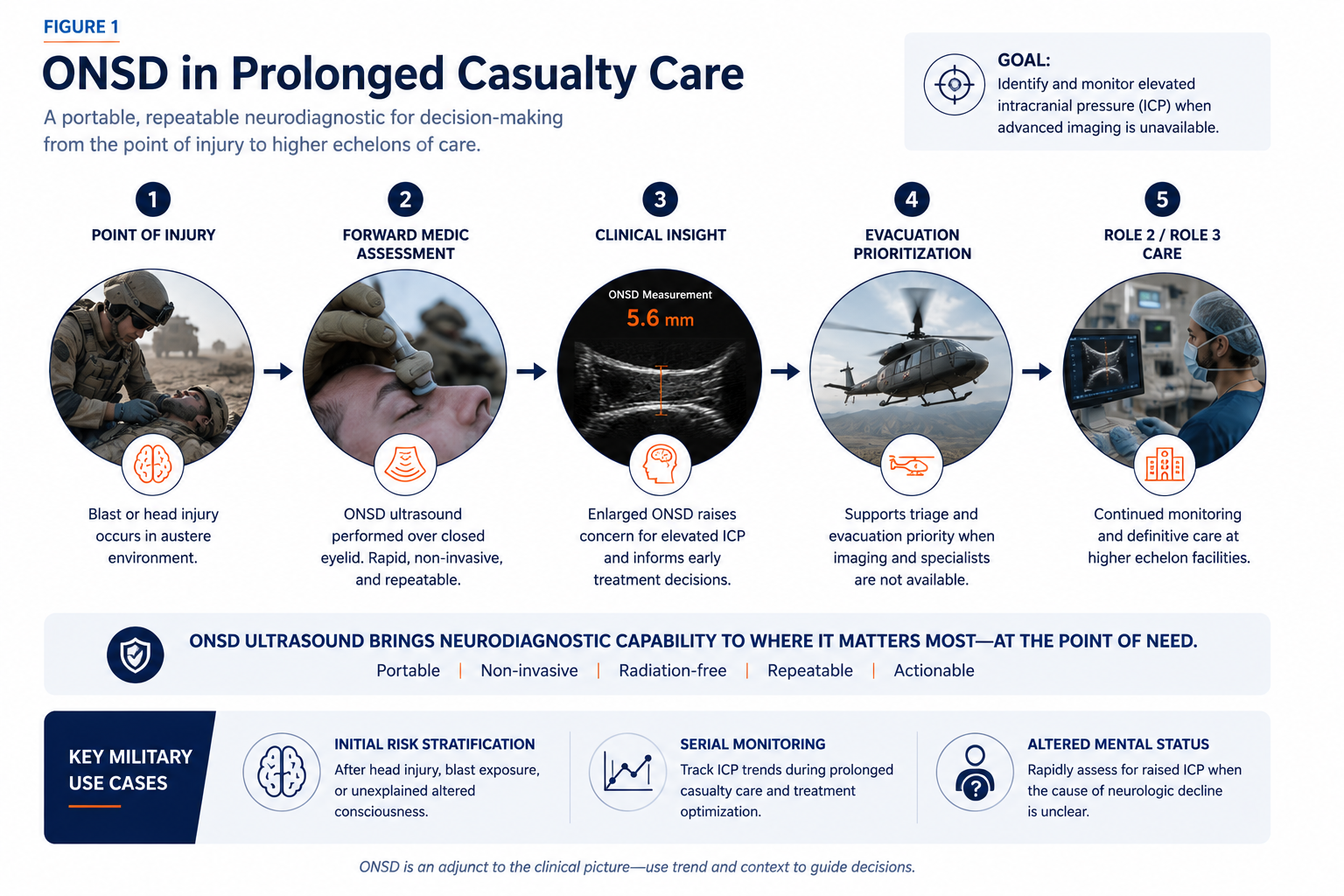
Optic nerve sheath diameter (ONSD) ultrasound leverages a straightforward anatomical principle: the optic nerve sheath communicates directly with the subarachnoid space, meaning elevated ICP causes measurable dilation of the sheath. A bedside ultrasound probe placed over the closed eyelid can detect that dilation in seconds; no radiation, no contrast, no specialized suite required.
The diagnostic evidence is strong. Koziarz et al. (2019) reported 97% sensitivity and 86% specificity across 71 studies and 4,551 TBI patients. Robba et al. (2018) found a pooled diagnostic odds ratio of 67.5. Kim et al. (2019) reported 99% sensitivity at a 5.0 mm threshold. These findings support the clinical basis for potential adoption in military settings.
ONSD Use Cases during Military Deployment
There are multiple potential uses for ONSD in military setting: initial risk stratification after head injury, serial monitoring during Prolonged Casualty Care, and evaluation of undifferentiated altered mental status.
Conclusion
Optic nerve sheath diameter ultrasound is a plausible and evidence-supported adjunctive neurodiagnostic tool for military medicine. Its strengths align closely with the demands of forward care: portable, non-invasive, repeatable, and capable of providing a meaningful physiologic signal when CT, MRI, invasive ICP monitoring, and specialist consultation are unavailable. It is not a replacement for definitive neurodiagnostic workup. But, in an austere environment, ONSD ultrasound may be one of the most practical tools available.

Figures were created specifically for this article series using original illustrations and AI-assisted graphic design tools. Clinical concepts were derived from the references cited in the accompanying text.