Category
Education
Year
2026
Market
Defense
Not all chemical agents injure the lung in the same way or on the same timeline. For clinicians and medics operating in chemical exposure scenarios, understanding which ultrasound patterns to expect, and when to expect them, is as important as knowing how to acquire the images. This post breaks down the expected lung ultrasound findings across the major classes of chemical inhalational agents: choking agents, nerve agents, vesicants, and toxic industrial chemicals.
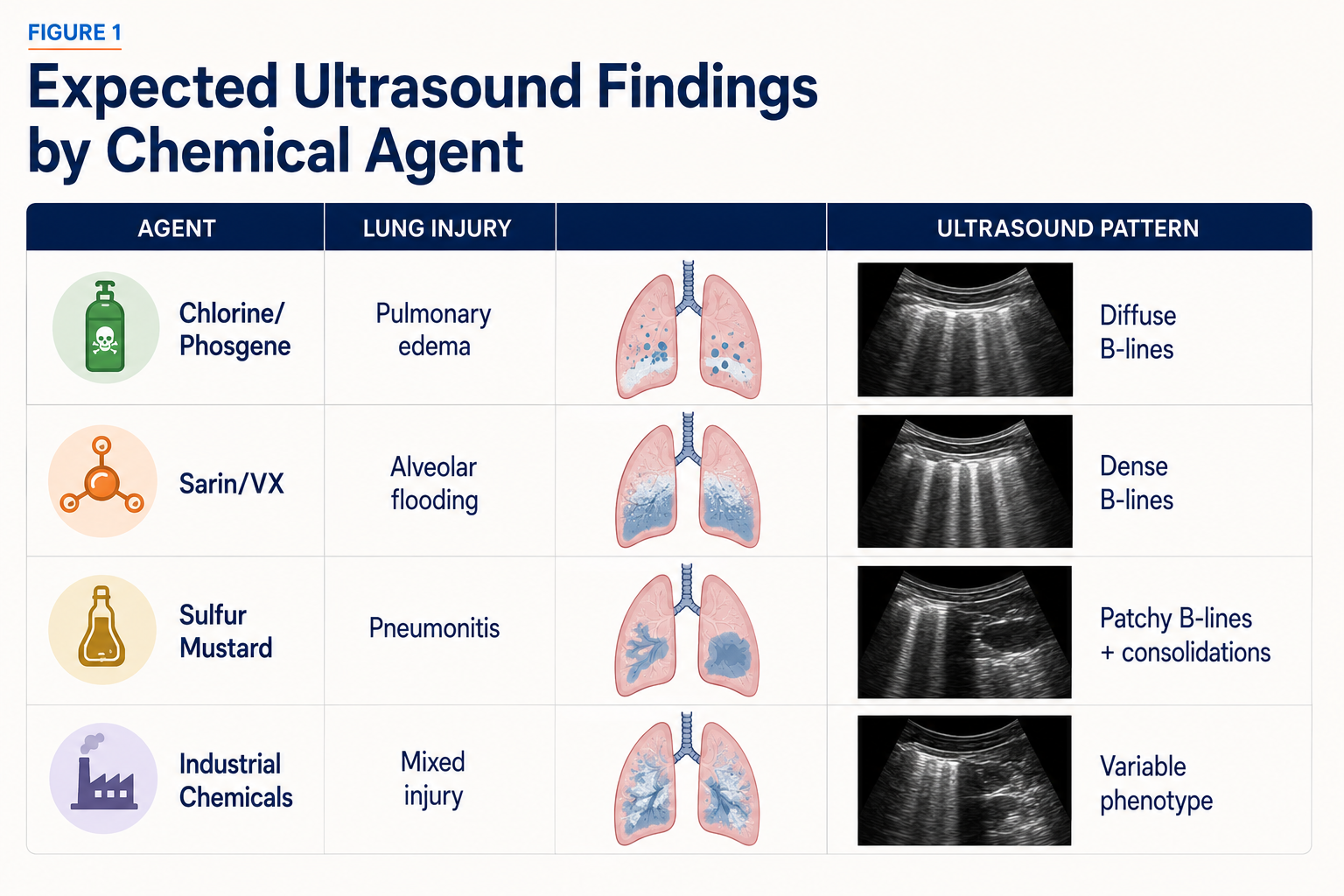
Chlorine and phosgene primarily injure the lungs, often causing acute lung injury and pulmonary edema. This can be detected on lung ultrasound as increasing numbers of B-lines and other signs of worsening pulmonary involvement. Phosgene exposure can lead to significant lung injury development after an initial symptom-free period; in this case, serial lung ultrasound examinations may help identify early deterioration and support timely triage and treatment decisions.
Nerve agents can trigger a life-threatening buildup of nerve signals throughout the body and may result in excessive fluid build up in the airways (bronchorrhea) and fluid accumulation in the lung's air sacs (alveolar flooding). From an ultrasound perspective, bronchorrhea and alveolar flooding may produce dense or coalescent B-lines.
Sulfur mustard causes dermal, ocular, upper airway, and pulmonary injury. With significant inhalational injury, expected findings include patchy B-lines, pleural line irregularity, subpleural consolidations, and later consolidation if chemical pneumonitis or secondary infection develops.The likely role of lung ultrasound in vesicant exposure is monitoring rather than exclusion.
Toxic industrial chemicals such as ammonia, nitrogen dioxide, chloramine, and industrial solvent exposures may produce chemical pneumonitis, bronchospasm, pulmonary edema, or delayed lung injury. Lung ultrasound patterns are expected to parallel choking-agent injury: scattered or diffuse B-lines, pleural line thickening or irregularity, patchy consolidation, and occasionally pleural effusion. Serial B-line monitoring may be useful when symptoms are evolving over hours.
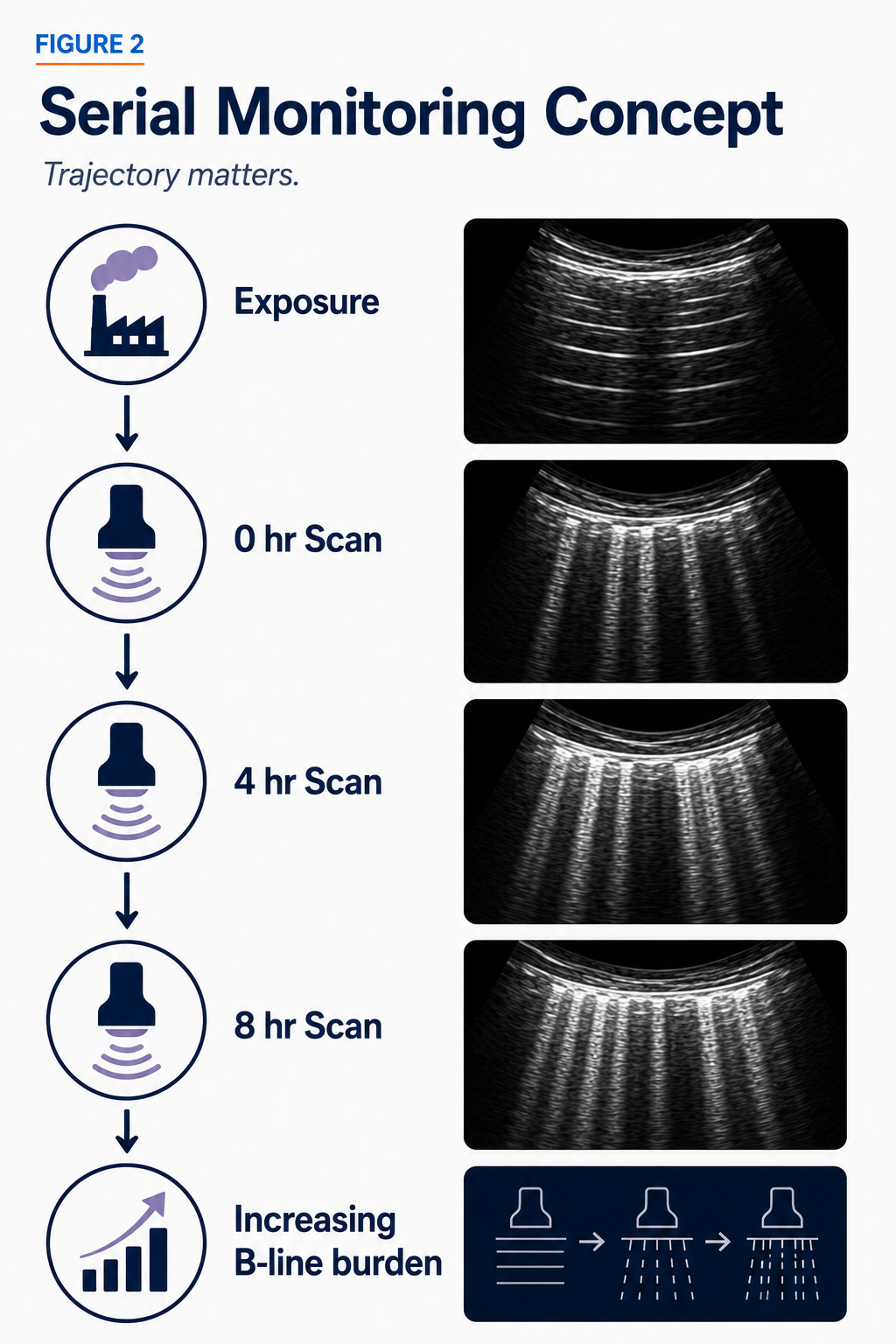
Across all chemical agent classes, a consistent theme emerges: a single scan may not be sufficient. The diagnostic and prognostic value of lung ultrasound in chemical inhalational exposure lies in both a binary presence or absence of B-lines, but also the trajectory of B-line burden over the observation window. Deep Breathe's AI-assisted lung ultrasound platform is designed to support exactly this. By automating B-line quantification and providing real-time acquisition guidance, it enables consistent serial monitoring by trained non-experts; the operational reality in mass casualty and military settings.

Figures were created specifically for this article series using original illustrations and AI-assisted graphic design tools. Clinical concepts were derived from the references cited in the accompanying text.
1. Lichtenstein DA, Mezière GA. Relevance of lung ultrasound in the diagnosis of acute respiratory failure: the BLUE protocol. Chest. 2008;134(1):117-25
2. Jambrik Z, Gargani L, Adamicza A, et al. B-lines quantify the lung water content: a lung ultrasound versus lung gravimetry study in acute lung injury. Ultrasound Med Biol. 2010;36(12):2004–2010.
3. Wright BS, Rezk PE, Graham JR, et al. Acute lung injury following inhalation exposure to nerve agent VX in guinea pigs. Inhal Toxicol. 2006;18(14):1049–1058.Wright BS, Rezk PE, Graham JR, Steele KE, Gordon RK, Sciuto AM, Nambiar MP. Acute lung injury following inhalation exposure to nerve agent VX in guinea pigs. Inhal Toxicol. 2006;18(6):437-448.
4. Chapman S, Lazar S, Gez R, Rabinovitz I, Yaakov G, Grauer E. Lung damage following whole body, but not intramuscular, exposure to median lethality dose of sarin: findings in rats and guinea pigs. Inhal Toxicol. 2019;31(5):203-211